History of SUPER THERM ®
INTRODUCTION
by J.E. Pritchett, President of Superior Products International II, Inc. :
" In 1990, contact was made with NASA's
Technology Utilization Office for help in developing a waterborne insulation
coating that could compete with or compliment batt forms of installed insulation.
After working through the different departments involved, I was directed to Mr.
Ismail Akbay, Director of the Technology Utilization Office. "
" Over the next several months of analyzing my base coating and the ceramic blends possible, the Utilization Office and their ceramic engineers suggested lists of literally hundreds of different ceramics to test for efficiency. I began gathering the ceramic compounds from all the worldwide sources recommended. After two years and hundreds of individual and combination compound tests, three specific ceramics were identified to work exceptionally well individually, and in combination with each other ( A fourth ceramic compound was introduced in February 2000 as part of our continued research in controlling heat transfer. This new compound is designed specifically for stopping Infrared Radiation to control the heat gain to the interior of buildings or equipment. ), to provide effective insulation to compete with, replace or compliment batt-type, foam or other bulk insulation products. "

THESE MULTI ~ CERAMIC
INSULATION COATINGS
ADDRESS ALL THREE MODES OF
HEAT
TRANSFER!
REPELS
RADIATED HEAT ~ REFLECTS
CONVECTED HEAT ~ RESISTS
CONDUCTED HEAT
Having
the ceramics correctly formulated was only half the approach to the formula. The
resin blend required to hold the ceramics and perform compatibly was the next
obstacle. Through many trials with high-performance resins ( 700+ ), the correct
combination was achieved to provide a proper vehicle for the ceramics, enabling
them to have a life of their own that could match the performance of the ceramic
powders. This is why we have the two acrylics, a single urethane and additives
in a balance for the formula. The coating was designed with two thoughts in mind
:
1) blend of different ceramic compounds for the highest reflectivity
and lowest conduction
2) blend of resins giving
the ceramics the necessary endurance and desired performance.
The
reflective coatings on the market have failed to realize that in addition to the
correct combination of different ceramics; the resins of the formula must match
the performance capability of the ceramics or the entire formula will fail.
The product that was developed from the NASA-aided research is known as SUPER THERM ®. Since the development of the product, SUPERTHERM
® has been in extensive field testing to judge its effectiveness
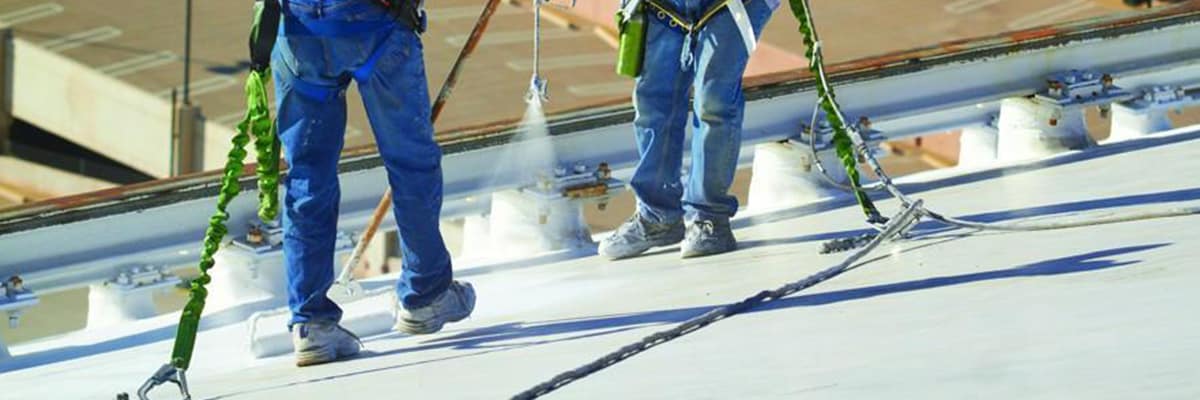
beginning in 1990 until present. Uses have ranged from applying to metal building
roofing, homes, industrial furnaces, oceangoing vessels, from tropical climates
to Alaskan freezes, from normal weathering to that inside of acid-burning furnaces,
from the UAE to the Pacific Rim and as far away as Russia and Japan.
CERAMIC
TECHNOLOGY USED IN THIS PRODUCT:
Superior Products International has been
experimenting with and developing the uses of "insulation and fire protection"
ceramics for over 10 years. This category of ceramic functionality is new to the
engineering fields. Only in recent years has the idea of insulation been associated
with this new breed of ceramics.
Superior Products International knew that this area had not been thoroughly explored before, nor had any extensive documentation been presented for this application. In contrast, many articles and studies have been devoted to the abrasion resistant ceramic compounds and how they can be used in manufacturing and industrial markets.
Insulative ceramics are completely different and separate from those used for abrasion resistance. As noted in this category, no extensive studies have been performed to determine which ceramic compounds, either natural or manmade would be best suited for eliminating heat transfer. Some studies have acknowledged the "reflection" of heat by mere radiation of sunlight but since very limited study has been performed, it was thought that reflection was all that this new category of ceramic could provide.
Superior Products International initially worked in the early 1990's with the aid of the Ceramic Engineers at the Marshall Space Center Laboratories, and it was discovered that no real research had been performed across the broad spectrum of possible ceramic compounds in order to determine the scope of ceramics stopping or slowing "heat conduction" rather than merely radiant heat reflection. It was also decided that Superior Products International would continue the R&D work over the next several years to discover the possibilities of this new design of ceramics. An extensive search was organized and begun to locate all possible types of ceramics compounds in the world market for trial-and-error testing. A system was designed to take each compound through a series of heat conduction tests to find its ability to stop heat conduction. More than 1,000 compounds were received and tested. From this R&D period, eight different compounds were identified as having the ability not only to catch and throw heat away from their surfaces in a manner similar to reflection but also to control heat conduction.
Superior Products International chose three of these ceramic compounds to develop its insulation coating called SUPER THERM ®. This is a thin film coating that will protect against heat migration equal to six inches of fiberglass batt insulation when applied over surfaces facing the heat source. SUNSHIELD 2000 is inferior to SUPERTHERM ® but is still superior to any of the cheap imitations on the market. SUNSHIELD 2000 is less expensive because the Fire ceramic \ resistance and urethane \ toughness have been left out. Any time a product is cheaper we have to ask ourselves, " what has been left out", don't we? SUNSHIELD 2000 does have the same dual acrylics and similiar multi ceramic insulation package. EPOXOTHERMlikewise has a similiar multi ceramic insulation package but in an Epoxy carrier. Epoxies are required for application to wet substrates such as in the case of extreme condensation.
Eight of the ceramic compounds were also chosen to work in combination with one another in high heat situations such as HOT PIPE COATING to 1000F \ 538C or REFRACTORY COATING to 2000F \ 1093C+ to capture surface heat, stop heat conduction or OMEGA FIRE (SP2001F) ( 3 hour Fire Resistance Rating ) to glaze or harden and stop flame, smoke or gas penetration. As with all of our protective coatings, each one is specifically engineered to solve a particular problem under a wide variety of application requirements and conditions.
ENVIRONMENTAL CONSIDERATIONS: SUPER THERM ® is extremely environmentally friendly. The VOC's ( Volitile Organic Compounds ) are only 67 grams/liter. The limit is 420 grams. SUPERTHERM ® is 4.2 times less toxic than that of typical latex paint which has a VOC of 250 g/L. SUPER THERM ® has received a " K " rating by NASA for toxic off gassing which is the highest rating available. In addition to the inherent thermal deficiencies in fiberglass, there is also the possibility of some inherent health concerns. For further information regarding the very real possibility of fiberglass being as carcinogenic as asbestos visit the Fiberglass Information Network (http://www.sustainableenterprises.com/fin/index.htm).